No products in the cart.
Most Christmas ornaments last two or three seasons. They chip, the glitter sheds, the printed face fades, and eventually the box gets thrown out. Meanwhile every family has one or two ornaments that have come out of the box every December for twenty years, and everyone knows which ones they are.
The difference is almost never price. It is material, and how the thing was made.
Here is what we have learned making and selling ceramic ornaments in Dubrovnik — and how to choose cat ornaments you will still be unwrapping in 2046.
Ceramic is the best bet for anything you intend to keep. Fired clay does not fade, does not yellow, and does not become brittle with age. It chips if dropped onto a hard floor, but it will not degrade sitting in a box. Hand-glazed ceramic also carries genuine colour depth that printing cannot reproduce.
Resin is what most mass-produced “collectible” cat ornaments are made from. It is cheap and holds fine detail, but the paint is applied on top of the surface rather than fused into it, so it scuffs — and after a decade in a warm attic, resin yellows.
Glass is beautiful and weighs almost nothing, which matters on a real tree branch. It is also the least forgiving material in the world for a household with an actual cat in it.
Wood survives everything, including being knocked off the tree repeatedly. It will not give you the colour of a glazed piece, but for a home with pets or small children it is the sensible compromise.
If you buy one ornament this year, make it ceramic. If you buy one for a family with a real cat who will personally test your tree’s stability, make it wood.
The cats of Dubrovnik’s Old Town are the reason this shop exists — they sleep on the city walls, run the side streets, and end up in more visitors’ photographs than half the monuments do. Our potters have been making them in ceramic for years.
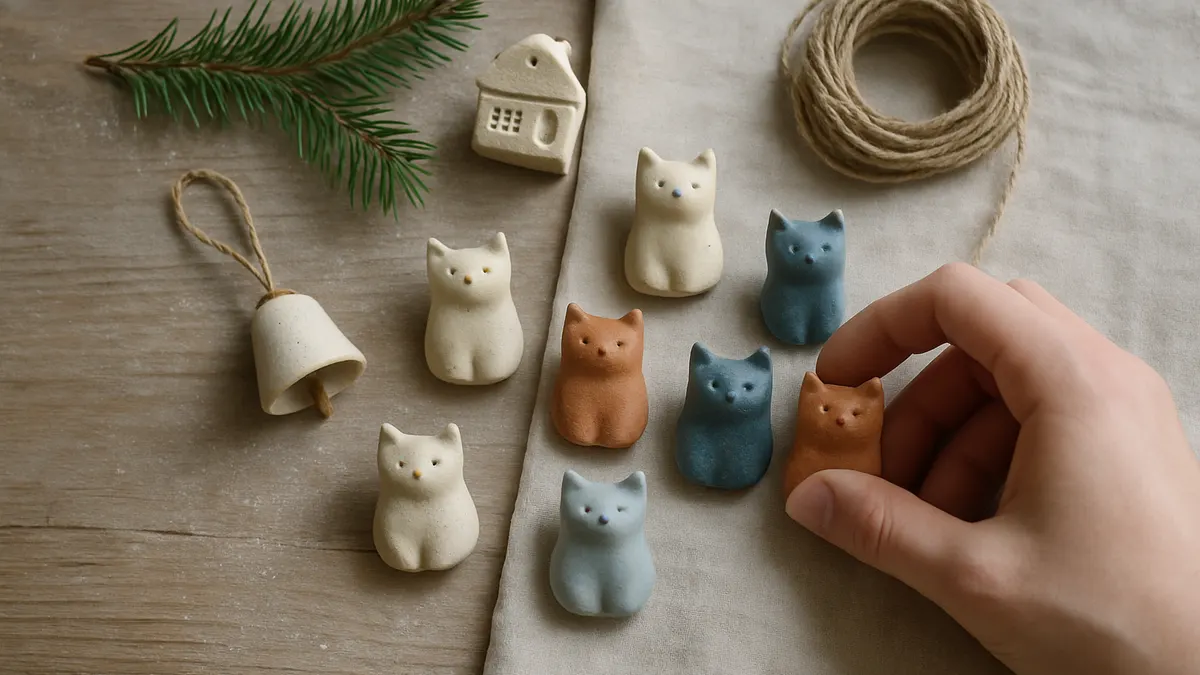
The ceramic cat family figurine set works either on a tree or on a shelf, which is worth thinking about — an ornament that has a life for the other eleven months of the year justifies itself much more easily. The scarf trio and spotted trio figurines are small enough for a branch and stable enough to stand on a windowsill.
For something with sound as well as shape, a ceramic bell is a traditional Mediterranean Christmas object that happens to hang perfectly. And the smiling cat face figurine is the piece visitors most often pick up, turn over, and then buy two of.
Our full Christmas and New Year collection sits alongside the ceramics and decor ranges, all made by the same small group of makers.
Some of the best tree decorations were never sold as such. Dubrovnik’s miniature stone houses — the arched window ornament and the dark stone house with a well — are modelled on the Old Town’s actual limestone architecture. On a tree they read as a tiny Mediterranean village. In January they go back on a shelf instead of into a box.
A Dubrovnik snow globe does the same job and is the one souvenir that children reliably choose for themselves.
This is where most ornaments actually die — not on the tree, in the eleven months afterwards.
Done properly, a fired ceramic ornament has no real expiry date. Museums hold glazed pieces that are several thousand years old, and the mechanism is exactly the same.
Cat ornaments are one of the easier gifts to get right, because the recipient has usually already declared their interest at length and without being asked.
Two things worth knowing. First, people who love cats generally already own a great deal of mass-produced cat merchandise — the gift that stands out is the handmade one. Second, an ornament is a gift that reappears every single December, which quietly makes it one of the highest-value small gifts there is.
If you want a wider range of ideas, our guide to the best gifts for cat lovers covers the non-seasonal options, and there is a gifts under €20 collection for secret-santa territory. If you happen to be shopping in Croatia itself, our guide to Croatian souvenirs worth bringing home explains what is genuinely made here and what is imported.
Everything above is made in and around Dubrovnik by a small group of potters and illustrators — our local artists collection lists who makes what. The shop is at Zlatarska 3 in the Old Town, a few minutes from the cathedral, and we ship worldwide for anyone who cannot get to Croatia in December.


Zlatarska 3
Old Town, Dubrovnik
Croatia
Working Hours
Daily · 9:00 – 21:00
Open during tourist season (May – October)
Dubrovnik's Cats d.o.o.
OIB: 73143328685
IBAN: HR41 2386 0021 1190 5303 0
Zlatarska 3, 20000 Dubrovnik, Croatia
Phone: +385 91 150 8018
Email: Dubrovniks.cats@gmail.com
We accept payment by debit and credit cards: Visa, Mastercard, Maestro and Diners Club.




Secure payments via Monri Payments

